Trikonasana (Triangle Pose) is a standing pose that stretches the sides of the body, the hamstrings and the hips and builds leg strength. Trikona means triangle and asana means pose, because your legs and arms form triangles. It is taught in many beginner classes. This guide gives clear steps, easier options and common mistakes, and says what can and cannot be claimed about its benefits.
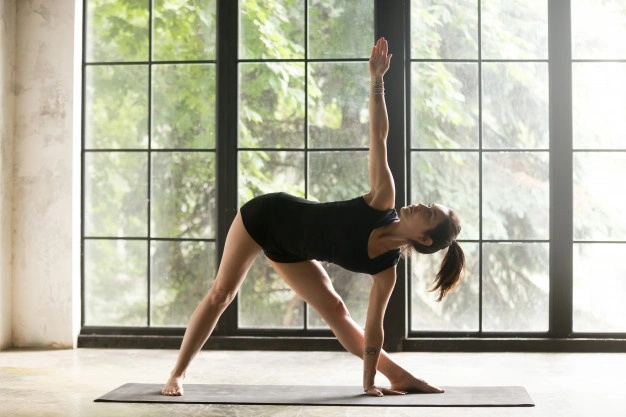
How to do Trikonasana step by step
- Stand at the long side of your mat and step your feet about 3 to 3.5 feet (around one leg length) apart.
- Turn your right foot out 90 degrees and your left foot in slightly. Line up your right heel with the arch of your left foot.
- Raise your arms to shoulder height, palms down, and keep your chest open.
- Inhale and reach your right arm out over your right leg. Keep both legs straight but do not lock your knees.
- Exhale and hinge from the hip, keeping your sides long. Rest your right hand on your shin, ankle, a block or the floor, whichever you can reach without collapsing your chest.
- Raise your left arm towards the ceiling, in line with your right arm. Turn your gaze up towards your left hand, or look forward or down if your neck feels tight.
- Stay for 3 to 5 slow breaths, then press into your feet and come up with an inhale.
- Turn your feet and repeat on the other side.
Triangle Pose (Trikonasana) step by step
Easier options and common mistakes
- Use a block or a wall: put your lower hand on a block, or lean your back against a wall to keep your chest open.
- Shorten your stance if your hamstrings or hips feel tight.
- Do not lock your front knee: keep a slight softness and press the outer edge of your front foot into the floor.
- Do not collapse forward: the pose is a sideways hinge, not a forward bend.
- Keep your neck comfortable: look down if turning your head up strains it.
- Breathe: if you cannot breathe easily, come out a little.
Looking for a perfect Yoga Teacher Training in Rishikesh?
Check out our 5 star rated 200 Hour Yoga TTC, 300 Hour Yoga TTC, 500 Hour Yoga TTC. Or our 7 days and 15 days yoga retreat in Rishikesh
Benefits of Trikonasana
Many people practise Triangle Pose because it:
- Stretches the hamstrings, calves, hips, chest, spine and the sides of the body.
- Strengthens the legs and ankles.
- Builds balance and body awareness.
- Gives a chance to practise slow, steady breathing, which many people find calming.
Research on yoga in general, summarised by the US National Center for Complementary and Integrative Health (NCCIH), suggests it may help with stress, mood, sleep and balance, and that the strongest evidence for pain is for low back pain, with a slight benefit. There is no evidence that Triangle Pose in particular treats diabetes, sciatica, constipation or acne, increases height or reduces fat in a specific area. If you have a health condition, ask your doctor which movement is suitable.
Who should take care
- Back pain, a slipped disc or neck problems: use a block, keep the pose small or skip it, and speak to a doctor first.
- High or low blood pressure, dizziness or migraine: avoid the pose, or practise gently under guidance and come up slowly.
- Pregnancy: ask your doctor and a prenatal teacher. Widen your stance and keep the pose gentle.
- Knee or hip problems: keep your front knee soft and do not push your range.
- Stop if you feel pain, tingling or sharp strain.
Related poses and next steps
Practise it after warming up with Surya Namaskar, and see our list of yoga poses for beginners. To learn standing poses with a teacher, see our 200 hour yoga teacher training in Rishikesh.
Sources: NCCIH, Yoga. Written by the Rishikesh Yoga Teacher Training Center team. This is general guidance, not medical advice.