100 Hour Yoga Teacher Training in Rishikesh India
A 14-day course with stay, vegetarian meals and airport pick-up included.
The programme at a glance
100 Hour Yoga Teacher Training in Rishikesh: overview
100 Hour Yoga Teacher Training in Rishikesh is a great opportunity for those who are a little short on time and would like to complete their 200 Hour Yoga Teacher Training Course in 2 parts. 100 Hour Yoga Teacher Training in India course offered by Rishikesh Yoga Teacher Training Center is suited for both beginner and intermediate level yoga practitioners. It is the first half of our 200 Hour Yoga Teacher Training, which is registered with Yoga Alliance (RYS 200).
The Course is a 14-day pre-YTTC course that covers the first section of our 200 Hour Yoga Teacher Training course syllabus. Upon completion of the 100 Hour Yoga Teacher Training Course, students can return anytime within 24 months to complete the second part of this course and become certified yoga teachers.
Our 100 Hour Yoga TTC course is designed specifically to heal your body and fill your mind with knowledge of traditional yoga practices.
The school serves 100% organic and Sattvic meals that will help you become more flexible and better at your yoga practices. Daily schedule is designed in such a way that you will be able to incorporate yoga and meditation in your daily life even after leaving our schools.
Daily timetable, Monday to Saturday
| 5:30 | Wake up |
|---|---|
| 6:00 to 7:30 am | Hatha Yoga |
| 7:45 to 8:45 am | Mantra chanting, Pranayama, Shatkarma & Meditation |
| 9:00 to 10 am | Breakfast |
| 10:30 to 12:00 pm | Therapeutic Alignment, Human Anatomy, Dynamic Physiology |
| 12:00 to 1:30 pm | Talk to expert,other important Sessions, self study |
| 1:30 to 2:30 pm | Lunch |
| 3:00 to 4:00 pm | Yoga Philosophy |
| 4:30 to 5:00 pm | tea Break |
| 5:00 to 6:30 pm | Ashtanga Vinyasa |
| 7:00 - 8:00 pm | Dinner |
Sunday is a full day off! Food and classes will not be available on Sunday (Accommodation is included on Sunday).
What is included
Your stay
- 14 Days Accommodation
- Nutritious Vegetarian, Vegan Meals
- Weekend Excursions
- Sound Healing Session
- Laundry & Weekly Room Cleaning
Also included
- Yoga Materials
- Full Body Massage
- Kirtan Night
- Free Pickup from Dehradun Airport
- Separate Diets for Allergic Individuals
Accommodation At Rishikesh Yoga Teacher Training Center
During your 100 hour yoga teacher training course, you will be staying at The Rishikesh Yoga Teacher Training Center in Rishikesh India. The location of the school is right next to the famous Lakshman Jhula(also known as the hanging bridge) and the holy river Ganges. The school provides a peaceful location to practice yoga as the ashram is situated close to the beautiful green mountains of the himalayas. Basic amenities like shops, cafes, restaurants, ATM and organic stores are located close to the ashram
The ashram offers both single and double room sets according to the student’s needs. The rooms are neat and clean and have attached bathrooms with western toilets and have a hot shower available.
The rooms also have an attached balcony with a beautiful view of the mountains and garden. Bedsheets, pillows, bath towels, toilet paper, blankets, and welcome amenities are provided to the students. Wifi is available on every floor and water and laundry services are also available.
Rishikesh yoga teacher training center also offers budget accommodations. These rooms are separate from the main building and don't have a balcony or mountain view. All of the other facilities are also available with these rooms.


Food At Rishikesh Yoga Teacher Training Center
Our food is known all over the globe for its taste and variety. All meals are prepared hygienically by an expert chef and the vegetables used are organically grown. Only vegetarian meals are served and are included in the fees of our 200 hour yoga teacher training in India course.
When diet is wrong medicine is of no use. When diet is correct medicine is of no need. ~Ayurvedic Proverb.
Eating the right type of food is an essential part of living a yogic life. Many people think that practising yoga is enough and they don't need to regulate their eating habits. At Rishikesh yoga teacher training centre we believe that yoga is not just an exercise for our mind and body but it is a way of living life. Yoga along with good eating habits can increase the benefits you get from doing yoga.
Message From Our Chef
The food we eat is not only necessary for our physical well being but also for good mental health. The classification of food in the world of yoga is a little different from the scientific world. Instead of classifying food in proteins, fats or carbohydrates the yogic food is classified as - Satva, Rajas and Tamas. Tamasic food makes us feel lazy or sluggish. Rajasic food makes you energetic and may cause restlessness whereas sattvic food makes you feel energetic, enthusiastic and light.
We at Rishikesh Yoga Teacher Training Center focus on the wellbeing of all our students so, all the students are expected to be on a sattvic diet during their stay at the ashram. Sattvic food helps to purify the body and calm the mind. The menu is designed by Master Chef Sandeep Semwal, with many years of experience in working at five-star hotels all around the globe, Chef Sandeep has a vast knowledge about sattvic diet and focuses on hygienic preparation of food so that it doesn't lose its nutritional value which is necessary for a healthy life. Eating too much or too little food can also cause problems even if you are eating healthy food. Overeating can cause lethargy and laziness and eating less than what you need would not provide you with enough energy for your daily routine. Sometimes we know that our stomach is full but we still eat more because of the taste. It is not possible to calculate the right amount of food someone needs using scales and other measurement techniques as every individual requires a different amount of food to function with full efficiency. So, we just need to listen to our body when it tells us to stop eating
It is said that the state of the mind of the person cooking/ eating also affects the food. The energy in the food cooked by someone while he/she was angry will definitely be lower than that of someone who cooked it with a feeling of love, contentment and gratitude. Listening to some soothing music or chanting while cooking and eating can help retain the Prana (life force energy) in the food. It is definitely worthwhile to pay some attention to the food that we eat as the ancient Indian texts say that we are what we eat!
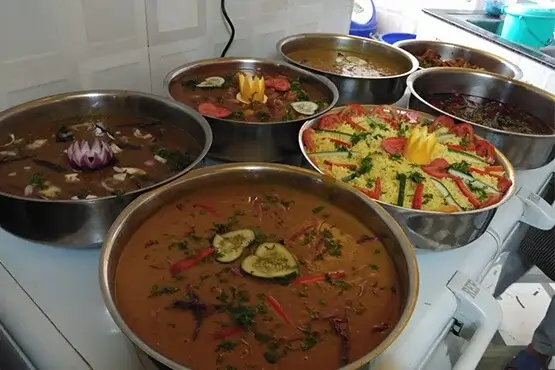
The following dietary requirement(s) are served and/or catered:
- Vegetarian
- Raw food
- Fruitarian
- Lactose-Free
- Organic
- Yogic
- Ayurvedic
- Other dietary requirements on request
If you have special dietary requirements it's a good idea to communicate it to the organiser when making the reservation.
100 Hour Yoga Teacher Training Rishikesh - Syllabus
YOGA PHILOSOPHY CURRICULUM
100 Hour Yoga TTC SEMESTER 1
- Introduction
- Origin of Yoga
- Different Paths of Yoga
- Ashtanga Yoga (8 Limbs)
- Yama
- Niyama
- Asana
- Pranayama
- Pratyahara
- Dharana
- Dhyana
- Samadhi
100 Hour Yoga TTC SEMESTER 2
- Hatha Yoga
- Obstacles in Yoga
- Panch Kosha
- Annamaya Kosha
- Pranamaya Kosha
- Manomaya Kosha
- Jnanamaya Kosha
- Anandamaya Kosha
- Sankhya Darshan
- Vedanta Darshan
HUMAN ANATOMY-PHYSIOLOGY AND YOGA
SEMESTER 1
- Introduction
- Skeletal System
- Joints and Range of Motion
- Ashtanga Yoga (8 Limbs)
- Muscular System
- Niyama
- Postural imbalances
- Physiology of Asana
- Back Bend
- Forward Bend
- Twist
- Inversion
- Written Assignment
SEMESTER 2
- Digestive System
- Respiratory System
- Circulatory System
- Physiology of Pranayama
- Nervous System
- Endocrine System
- Stress and Homeostasis
- Physiology of Meditation
- Lesson Planning, Practical Assessment and Written Assignment
Ashtanga Yoga
Ashtanga yoga is a way of internal purification for revealing the universal self, which consists of eight spiritual practices which syncs the movements of the body with the breath and mind.
Standing Pose
- Hasta Padangusthasana & Pada Hastasana
- Utthita Tri Konasana
- Parivrtta Tri Konasana
- Utthitan Parsva Konasana
- Parivrtta Parsva Konasana
- Prasarita Padottanasana A, B, C & D
- Utthita Parsvottanasana
- Utthita Hasta Padangusthasana
- Utthita Parsvasahita
- Utthita Eka Padasana
- Ardhabaddha Padmottanasana
- Ardhabaddha Padmottanasana
- Virabhadrasana A,B and C.
Primary Asanas
- Paschimottanasana A, B and C
- Purvottanasana
- ArdhaBaddha Padma Paschimottanasana
- Tirieng Mukha Eka Pada Paschimottanasana
- JanuSirsasana A,B and C
- Marichyasana A,B and D
- Navasana
- Lolasana
- BhujaPidasana
- Kurmasana
- GarbhaPindasana
- Kukkutasana
- BaddhaKonasana A & B
- Konasana A & B
Intermediate Asanas
- Salabhasana A & B
- Dhanurasana
- Ustrasan
- Kapotasana A & B
- SuptaVajrasana
- BakasanaA
- Bakasana B Jump
- ArdhaMatsyendrasana
- Yoga Nidrasana
- Tittibhasana
- PichaMayurasana
- PichaMayurasana
- Gomukhasana A & B
- Gomukhasana A & B
Advanced A (optional)
- Kasyapasana
- Bhairavasana
- UrdhvaKukkatasana A
- Galavasana
- EkaPadaViparitaDandasna
- VipritaSalabhasana
- GandhaBherundasana
- Hanumanasana
- Natrajasana
- Raja Kapotasana
Hatha Yoga
Hatha yoga is considered to be one of the best forms of exercises all around the world and helps with weight loss, improving health and overall condition of the body. It is advised to practice hatha yoga under the guidance of experts as it is considered to be one of the difficult part of learning yoga.
- Joint Movements.
- Surya namaskara ( sun Salutation) & Chandra Namaskara (moon salutation)
- Yoga Mudrasana
- Matsyasana
- Gupta Padmasana
- BaddhaPadmasana
- Lolasana
- Kukkutasana
- Garbhasana
Backward bending Asanas
- SaralBhujangasana (Easy cobra Pose)
- Bhujangasana (cobra Pose)
- TiryakaBhujangasana (twisting cobra pose)
- Sarpasana (snake pose)
- ArdhaShalabhasana ( half locust pose)
- Shalabhasana (locust pose)
- SaralDhanurasana (easy bow pose)
- Kandharasana (shoulder pose)
- ArdhaChandrasana (half moon pose)
- Setu Asana (bridge pose)
- Gomukhasana (cow’s face pose)
Forward bending Asanas
- Paschimottanasana (back stretching pose)
- GatyatmakPaschimottanasasna (dynamic back stretch pose)
- PadaPrasarPaschimottanasana (legs spread back stretch pose)
- JanuSirshasana (head to knee pose)
- Ardha Padma paschimottanasana (half lotus back stretching pose)
- Hasta PadaAngushthasana (finger to toe stretch)
- Padahastasana (hand to foot pose)
- SirshaAngusthaYogasana (head to toe pose)
- Utthitajanusirshasana (standing head between knees pose)
Spinal twisting Asanas
- ArdhaMatsyendrasana (half spinal twist)
- ParivrittiJanuSirsasana (spiralled head to knee pose)
Advanced pose
- Poornabhujangasana (full cobra pose)
- Kurmasana (tortoise pose)
- Poornashalabhasana (Full locust pose)
- PoornaDhanurasana (full bow pose)
- Dhanu-rakarshan-asana (archer’s posed)
- Chakrasana (wheel pose)
- Hanumanasana (leg splitting pose)
- Poornamatsyendrasana (full spinal twist pose)
- Mayurasana (peacock pose)
- Padma mayurasana (Lotus or bound peacock pose)
- Gorakshasana (Yogi Gorakhnath’s pose)
- Astavakrasana (eight-twists pose)
- Vrischikasana (scorpion pose)
- Inverted pose, balancing pose and core pose.
Shatkarma (Internal cleansing)
Shatkarma is a Sanskrit word which is made by 2 different words which is Shat plus Karma and also known as Shaktkriya. This is a traditional Yogic cleansing technique which is very effective and good to remove many illnesses and open the body blockages.
- Agni Saar
- JalNeti
- RuberNeti
- Tirieng Mukha Eka Pada Paschimottanasana
- Sutra Neti
- Dand
Meditation
- Candle Meditation
- Mantra chanting meditation
- Breathing meditation
- Bhajan/Kirtan
- Trataka
- Silence practise meditation
Human Anatomy
The basic structure and function of the organs and system is very important for the practitioners so that their work as a yoga teacher can be more enhanced. Knowing the different types of joints and their range of motions helps our students to be safe from injuries and also keep safe their students after they start teaching as a teacher.
- Types of bones
- Circulatory system
- Types of heart block
- Skeletal system
Yoga Philosophy
Yoga Philosophy includes theory related to yoga this part of the 200 Hour Yoga TTC at Rishikesh Yoga Teacher Training Center covers following topics :
- Introduction of Yoga
- Yoga Pantanjali sutra
- 5 basic Element
- Injuries & rest
- Integrating yoga in daily practice
- Principle of Yoga
- 8 limbs of Yoga
- Yoga therapy
- Yoga for stress, Migraine and Insomnia
- Yoga for Hypertension
- Yoga for heart problem, Blood pressure and Diabetic.
- Three Dosha
- The Nadi and kundalini.
- Basic knowledge of Chakra and Ayurveda
- Yogic diet
- Difference between Satvic & Tamasic food.
- Group discussion
- Clear doubt
Teaching Methodology
The teaching methodology is one of the most important parts of the 200 Hour Yoga TTC in Rishikesh as our students will learn the following:
- How to conduct a class
- Classroom management
- How to get in and come out from the posture
- How to assist & help while teaching the class
- Which kind of words you should be used as a yoga teacher
- What makes you different than other teachers in terms of teaching.
- Which kind of asanas you should recommend with a different health issue
- How to use belts, bolster, bricks and chair during the class adjustment.
Refund Policy
If you have paid the advance course fees and you are not able to come on your booking date please inform us so that we can recommend you the next upcoming date for the course but the fees will be not refunded.
How to apply for 100 Hour Yoga Teacher Training Course for our Rishikesh Location?
If you would like to book a seat for our 100 hour yoga teacher trianing course, please fill out this Registration Form and we will get back to you with all the details.
Frequently asked questions
What is the 100 hour yoga teacher training?
It is a 14-day pre-YTTC course that covers the first section of our 200 hour yoga teacher training syllabus. After completing it, students can return within 24 months to complete the second part and become certified yoga teachers.
How much does the 100 hour course cost?
The fee is USD 450 for a shared room and USD 550 for a private room, for the 14-day course.
What is included in the fee?
14 days of accommodation, nutritious vegetarian and vegan meals, weekend excursions, a sound healing session, laundry and weekly room cleaning, yoga materials, a full body massage, a kirtan night and free pick-up from Dehradun airport.
Are classes and meals available on Sunday?
Sunday is a full day off. Food and classes are not available on Sunday, but accommodation is included.
Who is the course for?
The course is suited to both beginner and intermediate yoga practitioners.
How do I ask about dates?
Use the enquiry form on this page or message us on WhatsApp. We reply within 24 hours with available dates and a quote.
Ask about dates and availability
Tell us when you would like to come. We reply within 24 hours with dates, the current price and travel help.