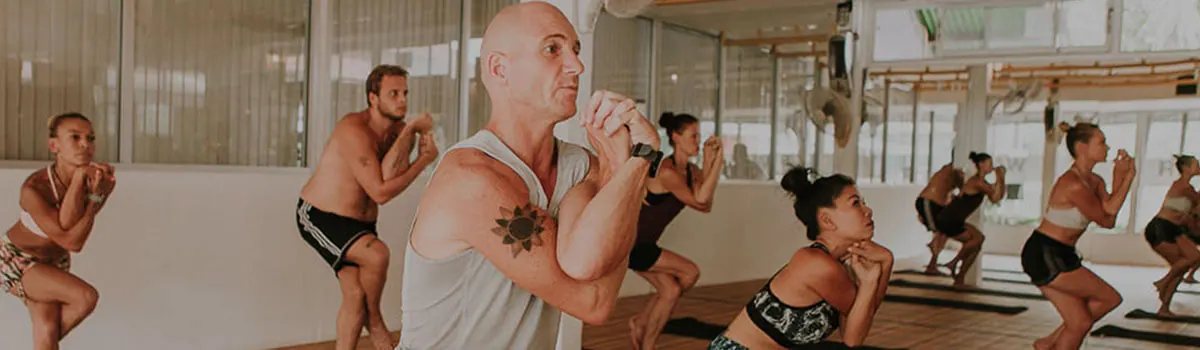
Bikram yoga is a style of hot yoga. Every class follows the same fixed sequence of 26 postures, which is 24 yoga poses and two breathing exercises, in a room heated to about 40 °C (105 °F) with around 40 percent humidity. A beginning class lasts 90 minutes. It is demanding, so it helps to know what to expect and how to look after yourself before you try it.
What is Bikram yoga?
Bikram yoga is a system of hot yoga taught in the same order each time, so you can compare how you feel from one class to the next. Studios usually have carpeted floors and mirrored walls, and teachers follow a standard spoken script and may adjust your posture. The heated room is meant to resemble the climate of India, and it makes you sweat heavily.
Where it comes from
The style is named after Bikram Choudhury, who was born in Calcutta in 1944, moved to the United States in 1971 and opened a school in Los Angeles in 1974. He devised the 26-posture sequence, based on the teachings of his own teacher B. C. Ghosh. Bikram yoga spread widely in the 1990s and 2000s, and the number of studios has since declined.
Two public matters are worth knowing about when you choose a class. In 2012 a US court ruled against Choudhury’s claim of copyright over the sequence, and an appeal court agreed in 2015, finding that a sequence of yoga postures is a system or method that cannot be copyrighted. He has also faced several lawsuits alleging sexual harassment and assault, which led to a judgment against him in one case. Many studios teach hot yoga without using his name, and you are free to choose a class based on the teacher and studio you trust.
The 26 postures and how a class runs
- The class opens with a standing breathing exercise and then moves through standing poses, balances and backbends.
- The floor series follows, with forward bends, twists and a closing breathing exercise.
- Poses are often held for a short time and repeated. You are encouraged to rest whenever you need to.
Looking for a perfect Yoga Teacher Training in Rishikesh?
Check out our 5 star rated 200 Hour Yoga TTC, 300 Hour Yoga TTC, 500 Hour Yoga TTC. Or our 7 days and 15 days yoga retreat in Rishikesh
What people report
People who practise Bikram yoga often say it builds stamina, strength and flexibility, and that the routine helps them focus. These are personal reports. We have not found good research showing special benefits of Bikram yoga over other kinds of yoga or exercise, and the article we checked lists no proven health claims for it.
What it cannot do
- It is not a detox: sweating is how the body cools itself. There is no good evidence that a sweaty class removes toxins.
- It is not a quick route to weight loss: the calories you burn depend on the effort you put in, and weight change comes mainly from food, activity and sleep.
- It does not boost immunity or heal injuries: we do not claim this, and you should see a doctor for any injury or illness.
Safety in a heated room
- The US National Center for Complementary and Integrative Health (NCCIH) says hot yoga carries a risk of overheating and dehydration.
- A published review of yoga-related adverse events included Bikram cases such as low blood sodium (hyponatremia), so drink water but do not overdrink, and stop if you feel unwell.
- Do not push through pain, dizziness, nausea or a pounding heart. Sit or lie down and leave the room if you need to.
- If you are pregnant or have a heart or blood-pressure condition, speak to your doctor first. NCCIH advises pregnant women to avoid hot yoga.
- Beginners should avoid forceful breathing and extreme poses.
If you are new to yoga
It can be easier to begin with a room-temperature class, learn the poses and then try a hot class. Read yoga poses for beginners and our Hot Yoga 101 guide. If you want to teach yoga, you do not need Bikram yoga; see our 200 hour yoga teacher training in Rishikesh.
Sources: Wikipedia, Bikram Yoga (the sequence, history, court rulings and the review of adverse events) and NCCIH, Yoga. Written by the Rishikesh Yoga Teacher Training Center team. This is general guidance, not medical advice.