
Yoga Anatomy for Beginners: Understanding the Body in Yoga
Yoga anatomy is the study of how the body’s bones, joints, muscles, connective tissue, and nervous system work together during yoga poses and breathing practices. It gives beginners a practical way to understand why a pose feels a certain way, and how to move through it safely.
Most people start yoga by focusing on how a pose looks — whether their hands reach the floor, whether their leg is straight, whether they can hold a balance. Very few beginners stop to ask a more useful question: what is actually happening inside the body while I do this?
That question is where yoga anatomy begins. It isn’t about memorizing muscle names or diagrams from a textbook. It’s about developing a basic, working understanding of how your skeleton, joints, and muscles move together, so that your practice becomes safer, more comfortable, and more aware.
This article introduces yoga anatomy in plain language — no medical jargon, no assumption that you already know how your body works. Just the basics every beginner benefits from understanding before going deeper into practice.
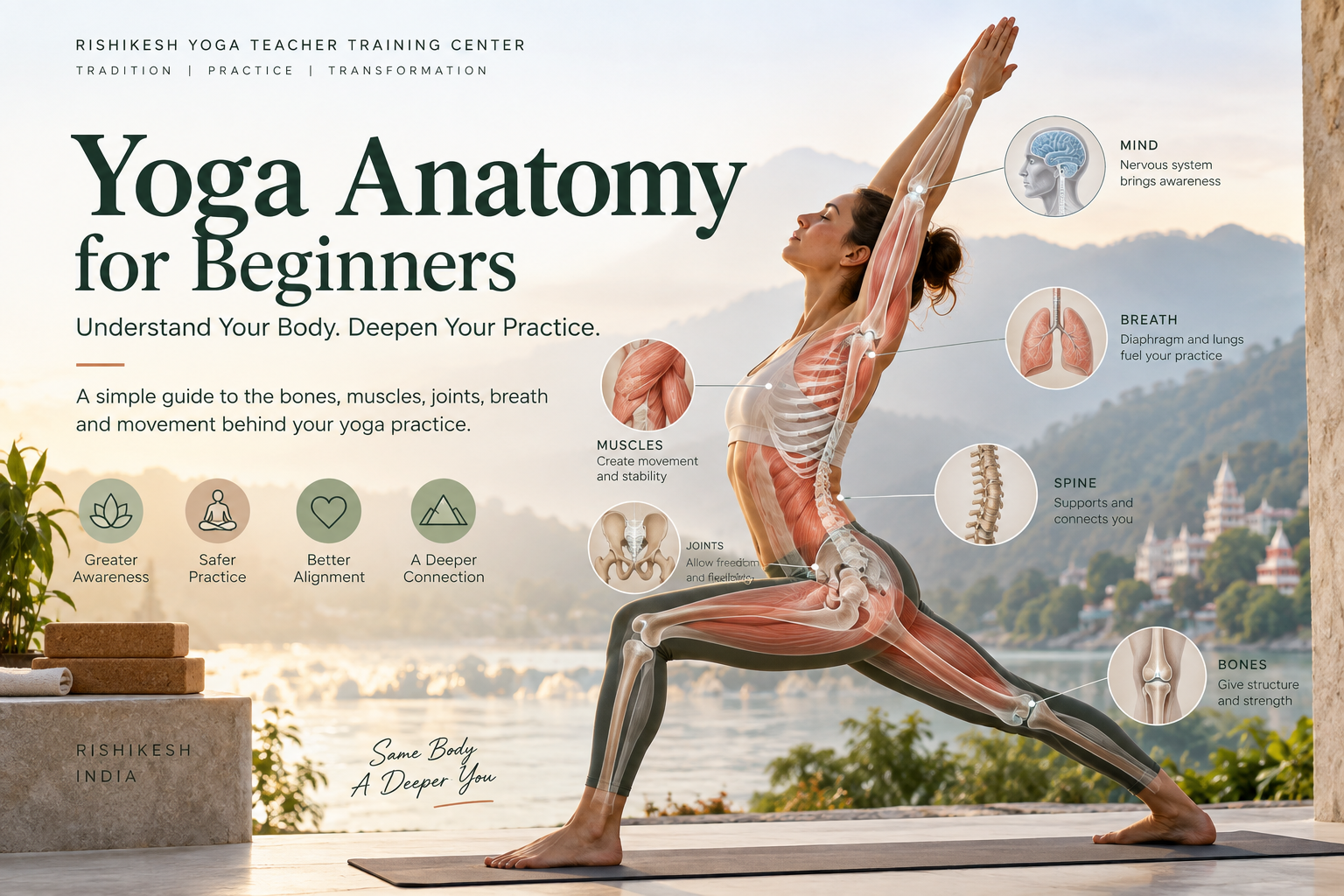
What Does “Yoga Anatomy” Actually Mean?
Yoga anatomy looks at how a handful of body systems work together every time you move into a pose. As a beginner, it helps to know roughly what each one does:
- Bones and joints give the body its structure and set the natural range of motion available in each part of you.
- Muscles contract, lengthen, and stabilize to create movement and hold a pose steady.
- Fascia, the connective tissue that wraps around muscles and joints, affects how a stretch actually feels and how far it goes.
- The nervous system coordinates balance, coordination, and the general sense of where your body is in space.
- Breathing connects movement to the nervous system and supports steadiness through the core during a pose.
You don’t need a scientific background to understand this. Think of it less as biology homework and more as learning the basic mechanics of a tool you already use every day — your own body. Once you understand a little about how it’s built and how it moves, yoga postures start to make a lot more sense.
The body doesn’t know what a pose is called.
It only knows how it’s being asked to move.
Why Anatomy Matters in Yoga
A yoga pose is really a set of instructions for the body — bend here, lengthen there, root down through this point. Without some understanding of anatomy, those instructions can feel abstract. With even a basic understanding, they start to feel logical.
Anatomy awareness helps you notice the difference between a healthy stretch and a warning sign of strain. It helps you understand why one pose feels easy on some days and difficult on others, based on how your joints and muscles are responding that day. And it helps you get more benefit from each pose, because you’re working with your body’s actual structure instead of just copying a shape you saw someone else make.
Basic Skeletal Concepts Every Beginner Should Know
You don’t need to memorize the name of every bone in the body. A few broad concepts are enough to start with:
- The spine is made up of small bones stacked on top of each other, with natural curves that give it strength and flexibility. Most yoga poses involve some movement of the spine — forward, backward, sideways, or in rotation.
- The pelvis acts like a base or foundation for the spine and legs. Its position changes how a forward bend or backbend feels, which is why the same pose can feel different in different bodies.
- Long bones, like those in the arms and legs, act as levers. Their length and the angle of the joints connecting them affect how far a stretch or movement goes.
The main idea to take away is that the skeleton provides structure, and yoga postures work with that structure rather than against it.
Major Joints and How They Move
Joints are where two bones meet, and they’re where almost all visible movement in yoga actually happens. A few joints come up again and again in practice:
- Shoulders — a highly mobile joint used in arm balances, backbends, and many standing poses.
- Hips — central to forward bends, twists, and seated postures; hip mobility varies a lot between individuals.
- Knees — primarily bend and straighten; they are sensitive to twisting forces and benefit from careful alignment.
- Spine joints — allow bending, extending, and rotating, and are involved in nearly every pose in some way.
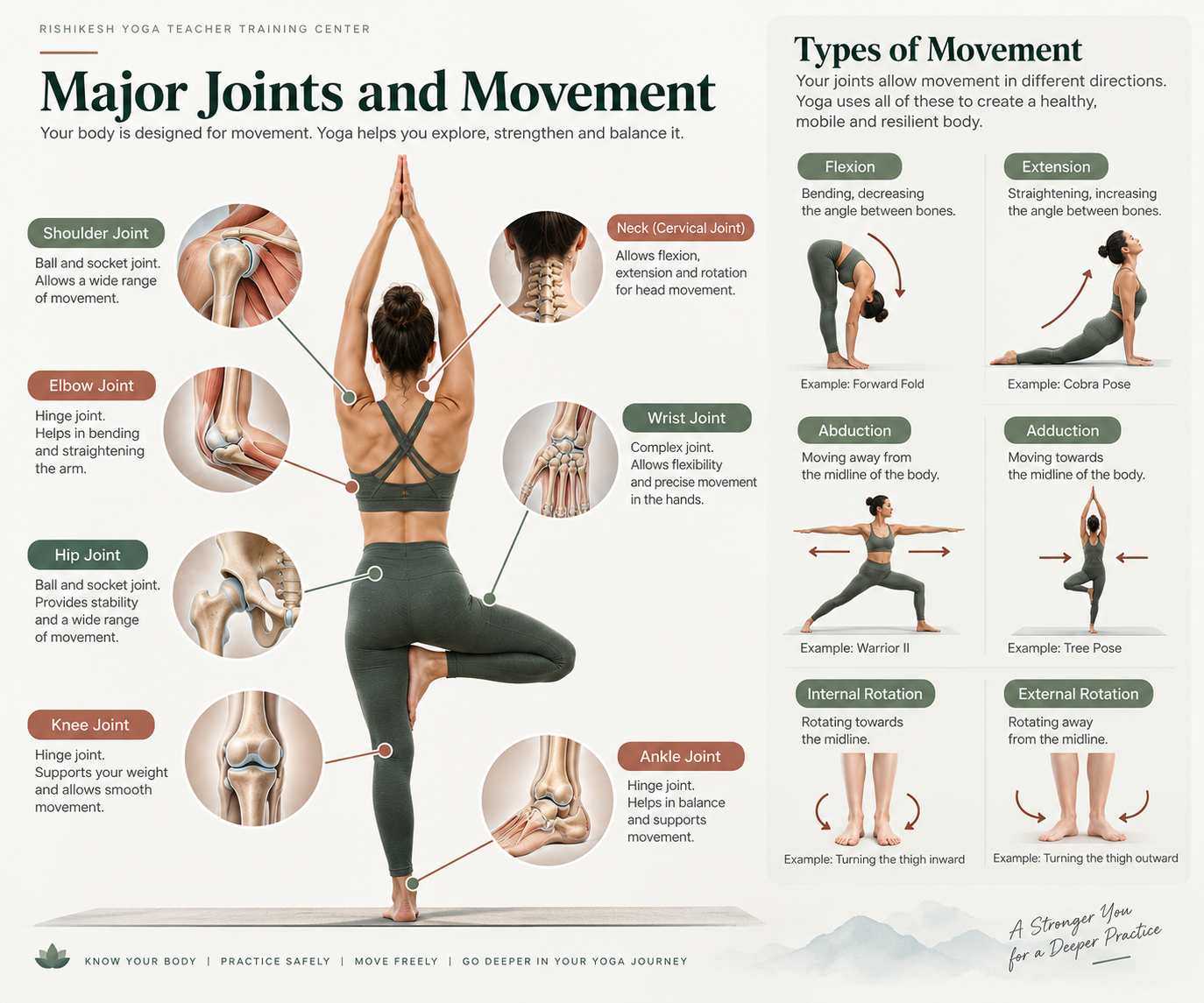
Different joints are built to move differently. A hip, for example, is designed for a wide range of motion, while a knee is designed mainly to bend and straighten. Respecting what each joint is actually built to do is one of the simplest ways to practice more safely.
Major Muscle Groups Relevant to Yoga
Muscles are what actually create movement and hold the body steady in a pose. Beginners don’t need to know every muscle by name, but it helps to recognize a few broad groups:
- Core muscles, around the abdomen and lower back, support the spine and help maintain balance in almost every pose.
- Hip and leg muscles power standing poses, lunges, and balances, and are heavily involved in forward bends and twists.
- Shoulder and upper back muscles support arm balances, backbends, and any pose where the arms bear weight.
- Muscles along the spine help you sit, stand, and move with better posture, both on and off the mat.
As you practice, you’ll start to notice which muscles feel engaged in different poses. That noticing, over time, is a large part of what “understanding your anatomy” actually means in a practical sense.
Two words come up constantly in yoga, and beginners often use them interchangeably.
They mean different things.
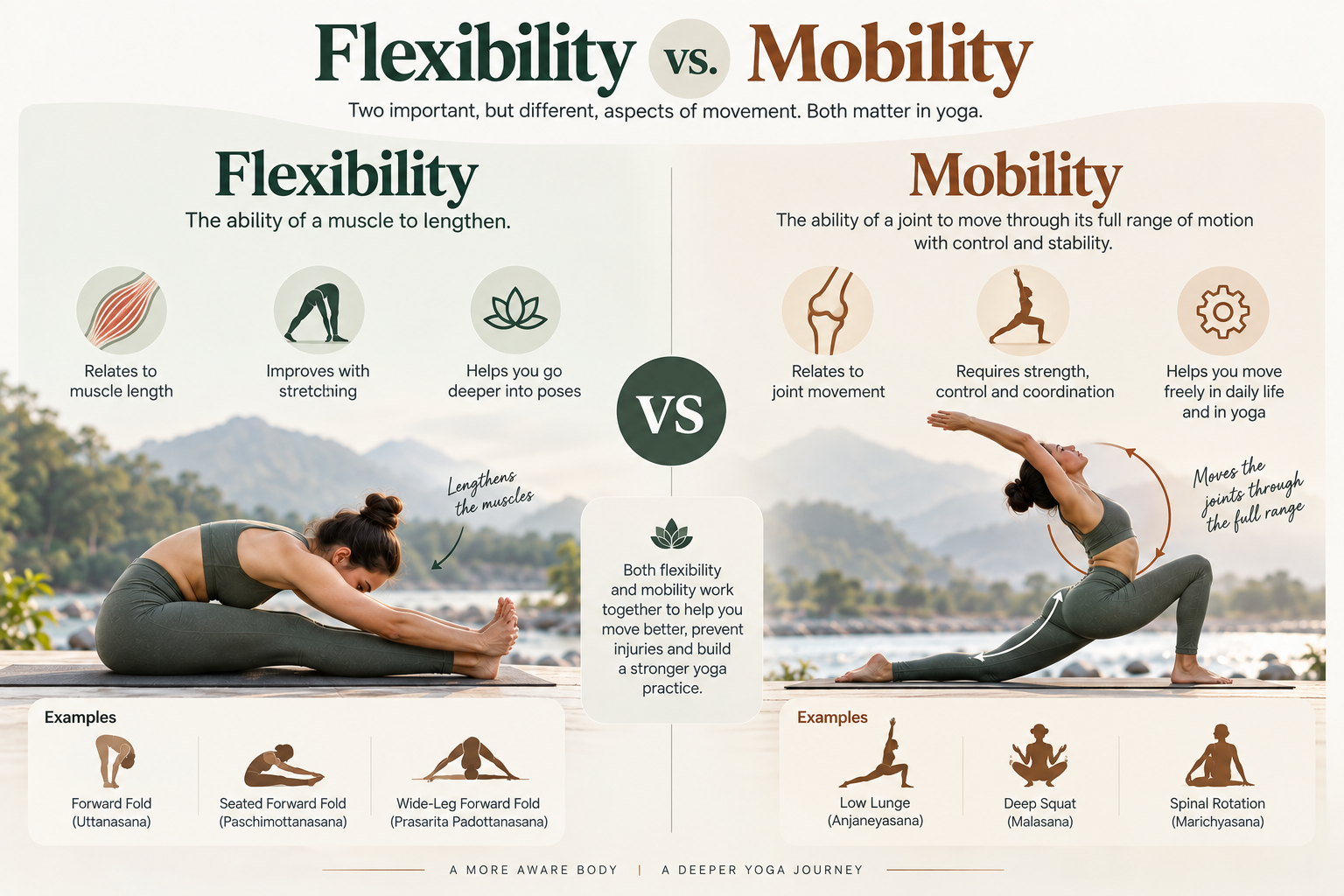
Flexibility vs. Mobility
Flexibility is about how far a muscle can lengthen. It’s what allows you to fold further into a forward bend or reach deeper into a stretch.
Mobility is about how well a joint can move through its range with control and strength, not just passive stretch.
It’s possible to be flexible in a muscle without having good mobility or control in the related joint, which is one reason some very flexible practitioners still experience discomfort or instability in certain poses. A well-rounded practice generally develops both qualities together, rather than chasing flexibility alone.
Stability and Strength: The Other Half of the Picture
Yoga is often associated with flexibility, but stability and strength are just as important. Holding a pose steadily, controlling the speed of a movement, and supporting your own body weight all rely on strength, not just range of motion.
A pose that looks purely like a stretch, such as a standing forward bend, often requires real strength in the legs and core to hold safely and with good form. Beginners sometimes push for depth in a stretch before they’ve built the stability to support it, which is one of the more common causes of strain in early practice.
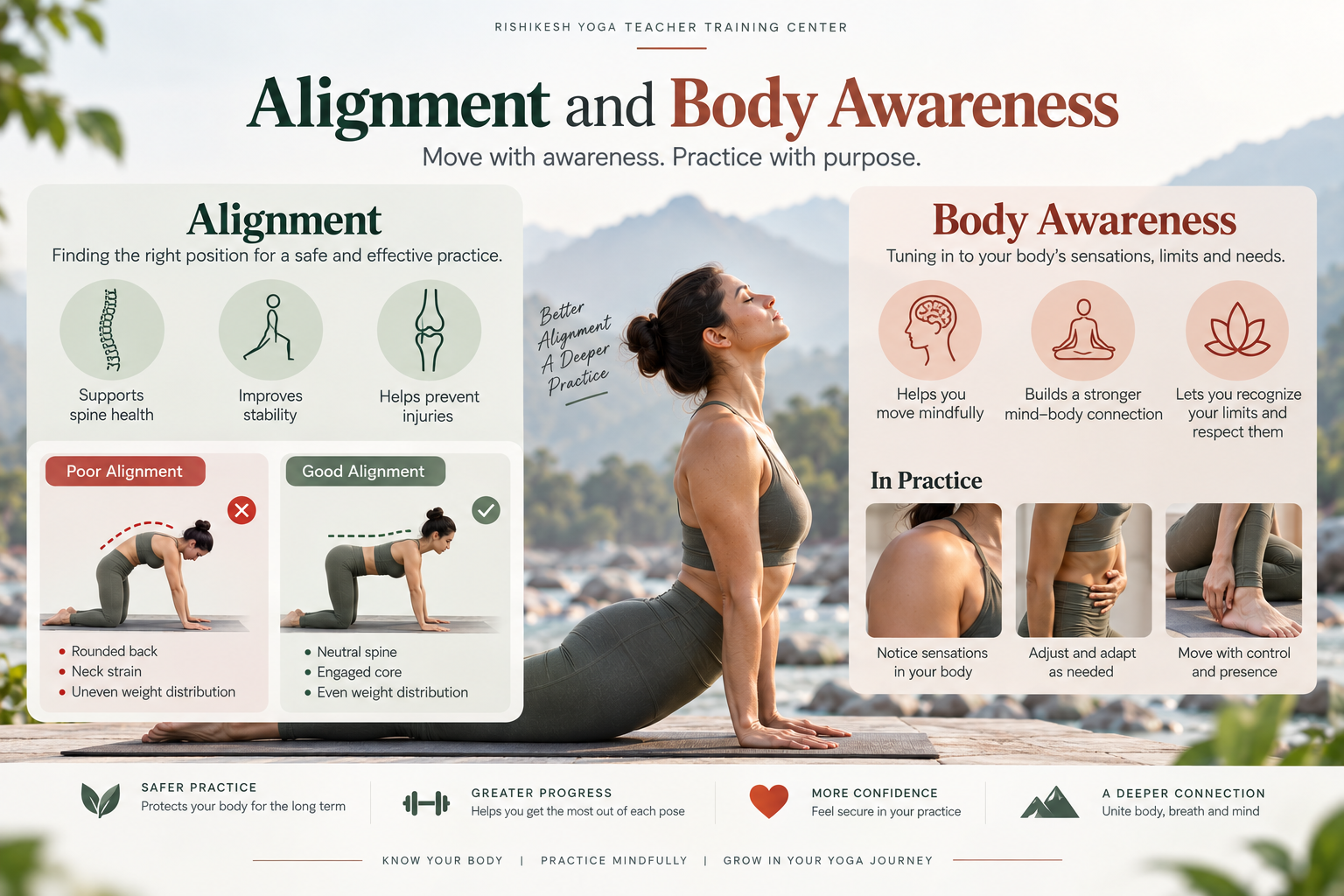
Alignment and Body Awareness
Alignment refers to how your joints and body segments are positioned relative to each other in a pose. Good alignment distributes effort sensibly across the body rather than concentrating stress on one vulnerable point, such as the lower back or a knee.
Alignment isn’t about achieving one “correct” shape that looks identical on everyone. Bodies are proportioned differently, so the same pose can look slightly different from person to person while still being aligned and safe for that individual. What matters more than matching a picture is developing body awareness — the ability to sense where your weight is, whether a joint feels supported, and whether an area feels overstretched.
A Few Poses Worth Studying Closely
Anatomy concepts become much clearer once you connect them to a real pose. A handful of common postures are especially useful for beginners to study, because each one highlights a different part of the body in action:
- Mountain Pose (Tadasana) — a good place to study standing alignment and how weight is distributed evenly through the feet.
- Downward-Facing Dog — involves the shoulders, spine, hips, knees, and ankles all at once, making it a useful full-body reference pose.
- Warrior II — useful for observing hip, knee, and ankle positioning in a standing lunge-style stance.
- Child’s Pose — a gentle way to feel hip and spinal flexion without much effort.
- Cobra Pose — introduces spinal extension along with shoulder and chest opening.
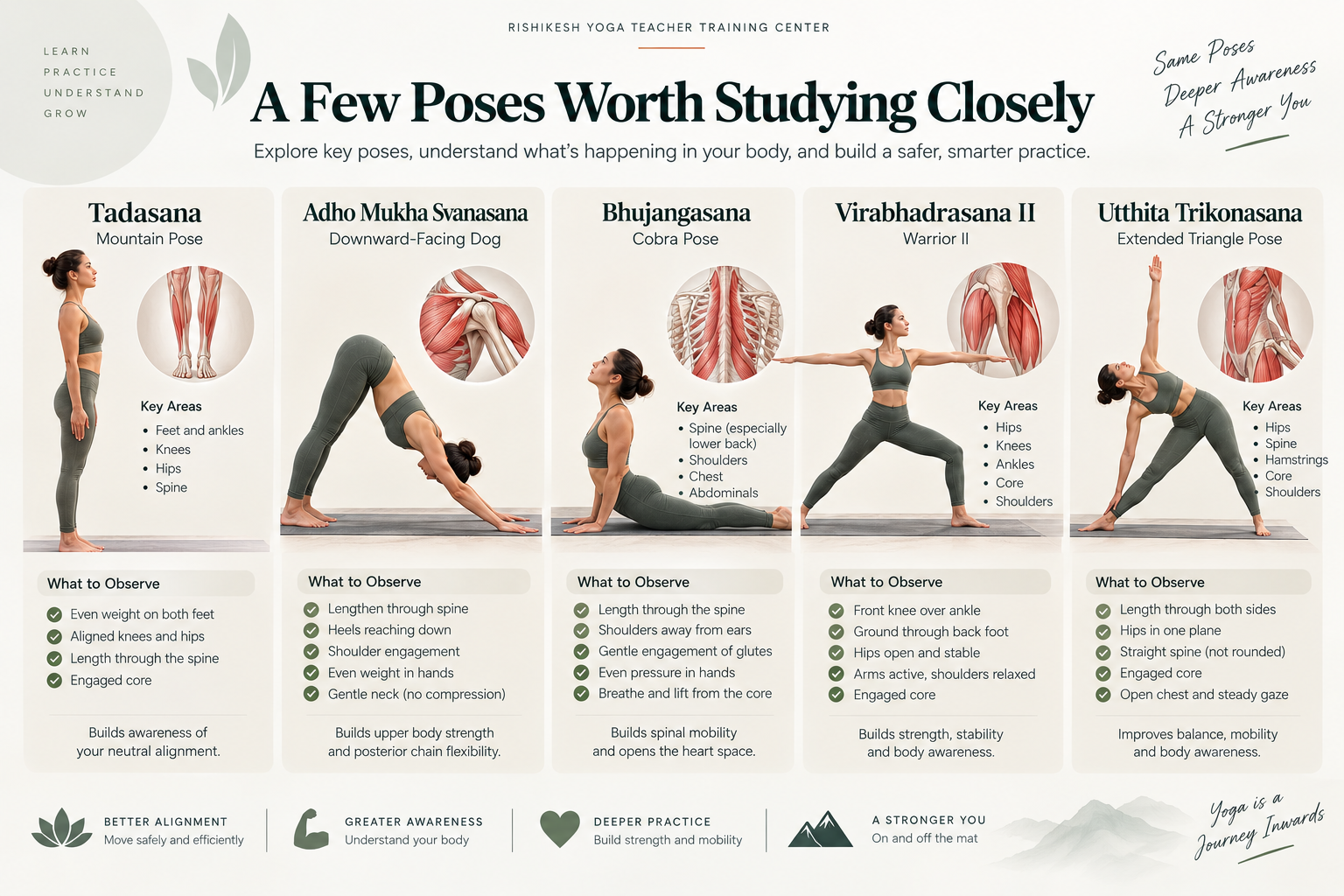
You don’t need to master these poses to learn from them. Simply noticing which joints are moving and which muscles feel engaged in each one is enough to start connecting anatomy concepts to your own practice.
How Anatomy Helps You Practice More Safely
None of this needs to be complicated to be useful. A basic sense of anatomy helps in a few very practical ways:
- You start to recognize the difference between a normal stretching sensation and a sign of joint strain.
- You understand why a teacher gives certain alignment cues, instead of following them without knowing the reason.
- You become more comfortable modifying a pose for your own body, rather than forcing a shape that doesn’t suit your current mobility or strength.
- You build a habit of listening to the body during practice, which carries benefits well beyond the yoga mat.
This kind of awareness doesn’t replace guidance from a qualified teacher, especially if you have an existing injury or health condition. But it does make you a more informed participant in your own practice.
These basics are enough to begin practicing with more awareness.
What Beginners Should Understand Before Going Deeper
You don’t need to master anatomy before starting yoga — understanding grows naturally alongside practice. What helps most in the beginning is simply staying curious: noticing which joints are moving in a pose, which muscles feel like they’re working, and whether a sensation feels like healthy effort or something closer to strain.
A good principle to hold onto as a beginner: anatomy explains what is possible for your body, not one single “correct” shape to force yourself into. Bone structure and joint mobility differ from person to person, which is why the same pose can legitimately look different across different bodies, and why comparing your shape to someone else’s is rarely useful.
Over time, many practitioners want to understand these concepts in more depth, sometimes because they’re considering more structured study, or even teaching. At that stage, the anatomy, philosophy, and practical teaching skills involved usually form part of a proper yoga course, where the material can be studied and practiced with guidance rather than pieced together informally.
If you find yourself wanting that kind of structured foundation, this guide on how to choose the right yoga course is a useful next step. It walks through what to look for in a course — from curriculum and teaching style to certification and course duration — so you can find a program that actually matches where you are in your practice.
Understanding your body is not a separate subject from yoga.
It is one of the quiet foundations the practice is built on.